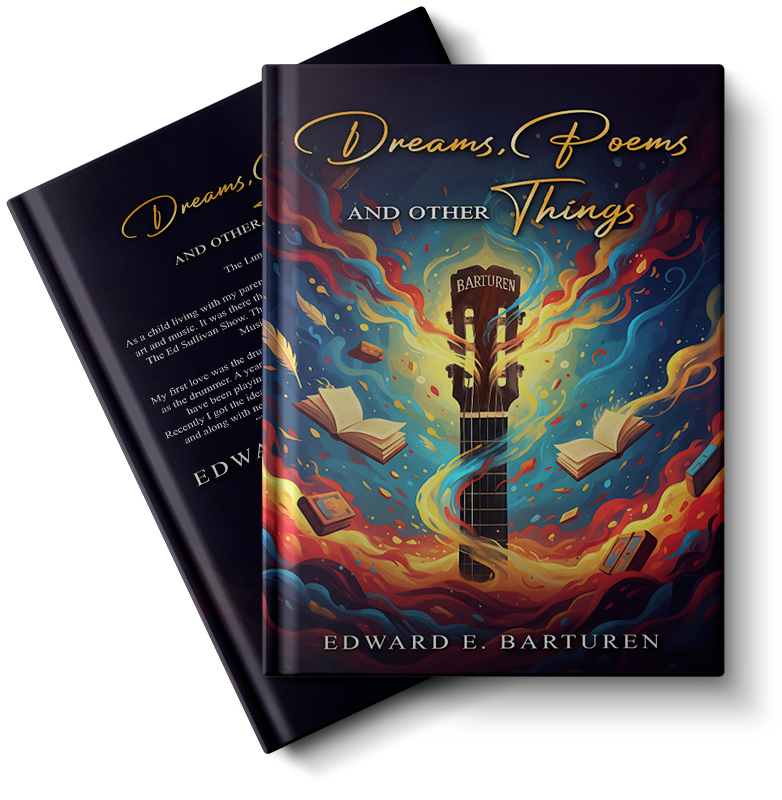
In a world that moves too fast and listens too little, we often lose sight of who we truly are. The noise of expectations, the rush of routine, and the weight of time can make us forget the quiet, divine spark within us. The one who once dreamed freely. In Dreams, Poems and Other Things, Edward E. Barturen extends a gentle hand to the reader, guiding us back to that place of stillness and truth.
Through poems like Who I Am, Here in My Dreams, and The Lunacy of Today, Edward reminds us that rediscovery is not about changing who we are. But about remembering who we’ve always been.
Journey Back to Self
In his poem Who I Am, Edward writes,
“I take off the wig, I ripped off the mask.
My face is the same,
Nothing else has changed.”
These lines strike with quiet honesty. They are a revelation. They speak to the courage it takes to remove the layers the world has built around us, to stand unguarded and authentic.
Edward’s verse isn’t about rebellion or defiance. It’s about peace. He reminds us that self-discovery isn’t found in becoming someone new, but in returning to the self we once abandoned in the pursuit of approval or success. His poetry serves as both a mirror and a map. They reflect the soul’s truth while pointing the way back home.
He celebrates individuality with tenderness, suggesting that the most sacred act of love is to embrace ourselves, exactly as we are.
Language of Dreams
Dreams, in Barturen’s world, are not illusions. They are messages. In Here in My Dreams, he writes,
“I fell in love with a girl in my dreams.
No words were ever spoken.”
Here, dreams become a sacred space where the boundaries of reality fade, and the soul is free to create, feel, and heal. His imagery feels like music. Ethereal yet grounding, guiding readers to believe that what we dream of may, in some way, already belong to us.
His poetry blurs the line between the waking world and the world within. He invites readers to see their dreams not as fantasies, but as reflections of what their hearts most desire: peace, love, connection, and meaning.
In this way, Dreams, Poems and Other Things becomes a doorway. Through it, readers are reminded that dreams are not escapes. They are expressions of faith in what could be.
Faith in the Light Within
One of Edward’s most striking pieces, The Lunacy of Today, shows the delicate balance between chaos and calm, doubt and belief.
“The lunacy of today began last night,” he writes, a line that feels both haunting and intense. It’s a reminder that confusion, pain, and uncertainty are not signs of weakness. They are part of the human condition, and they, too, carry meaning.
His faith is not rigid or doctrinal. It is spiritual in the purest sense. It lives in hope, in empathy, and in the belief that no darkness lasts forever. His verses illuminate the truth that even in moments of solitude or struggle, we are never truly alone. There is always a voice, a whisper from the divine, calling us back to the light within.
Soulful Companion for the Human Journey
Reading Dreams, Poems and Other Things feels like sitting with an old friend who understands your heart. Barturen’s voice is gentle yet wise, poetic yet profoundly real. His work invites readers to pause, breathe, and rediscover what truly matters: love, faith, and authenticity.
Each poem is a reminder that within every person lies a story, a light, and a purpose worth remembering. His art is not simply about poetry. It’s about healing, reminding us that even after years of silence, our souls still know the melody.
If you’ve forgotten how to listen to your heart, let Edward Barturen’s words remind you.
Find your dreams, your faith, and the beauty of your true self in Dreams, Poems and Other Things. A poetic journey back to who you were always meant to be.